Barthelme in 13
He deserves a diorama but instead I offer one of his fictional portraits in miniature
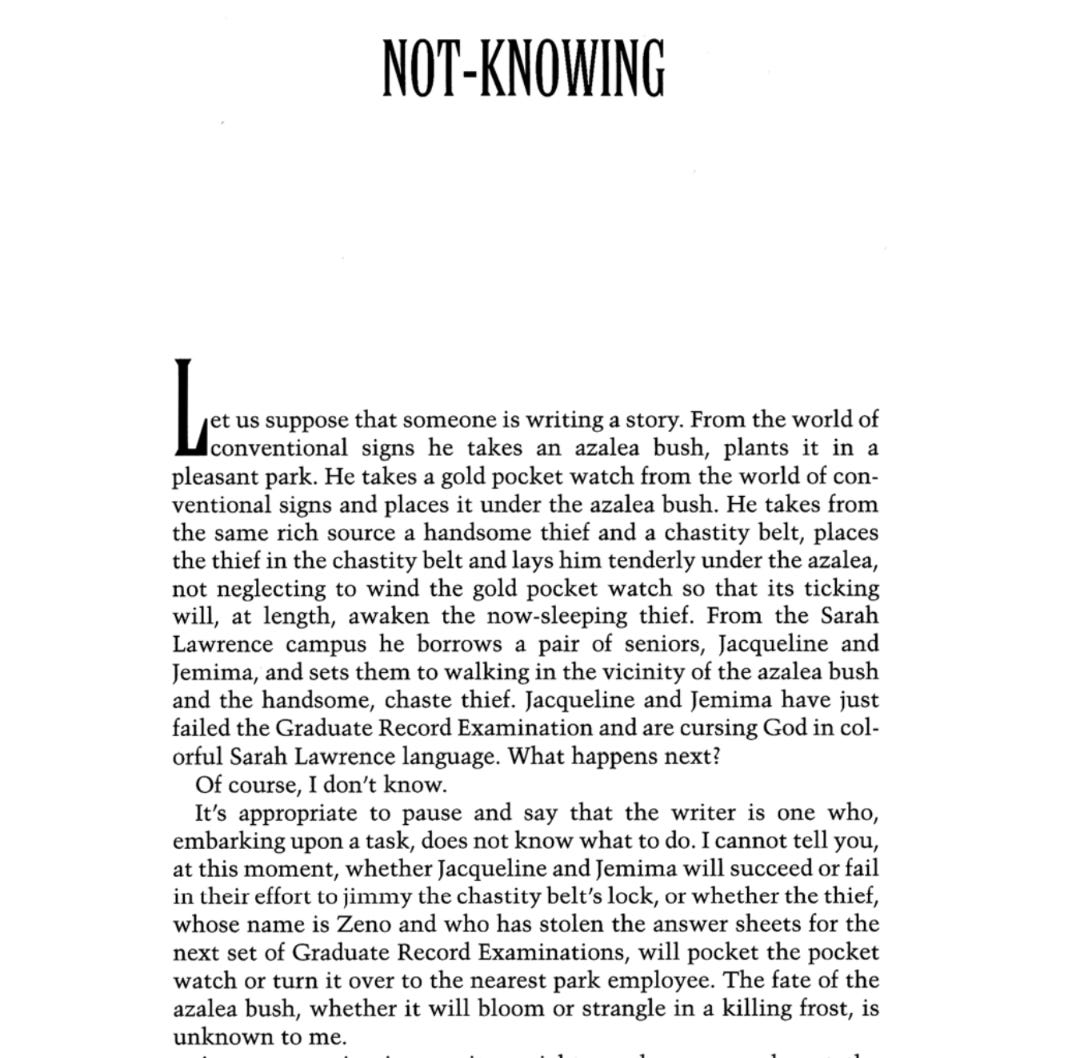
I think I love him for “Not Knowing” more than I love him for the fictions in which he evidences this.
Donald Barthelme never wrote a thing that wasn’t in dialogue with a piece of music, an artwork, a book, or an event from real life. Take his uber-short “Bishop”, for example, which paints a portrait-in-miniature of Bishop, an alcoholic who happens to be a writer working on a biography of the painter William Michael Harnett when he discovers a different painter named John Frederick Peto. Two paintings acquire the patina of characters in Barthelme’s tale.
First comes William Michael Hartnett’s Still Life with Three Castles Tobacco (1880), which features a broken match pointing its singed tip towards the spilled inkwell, as well as a folded letter on the green book.
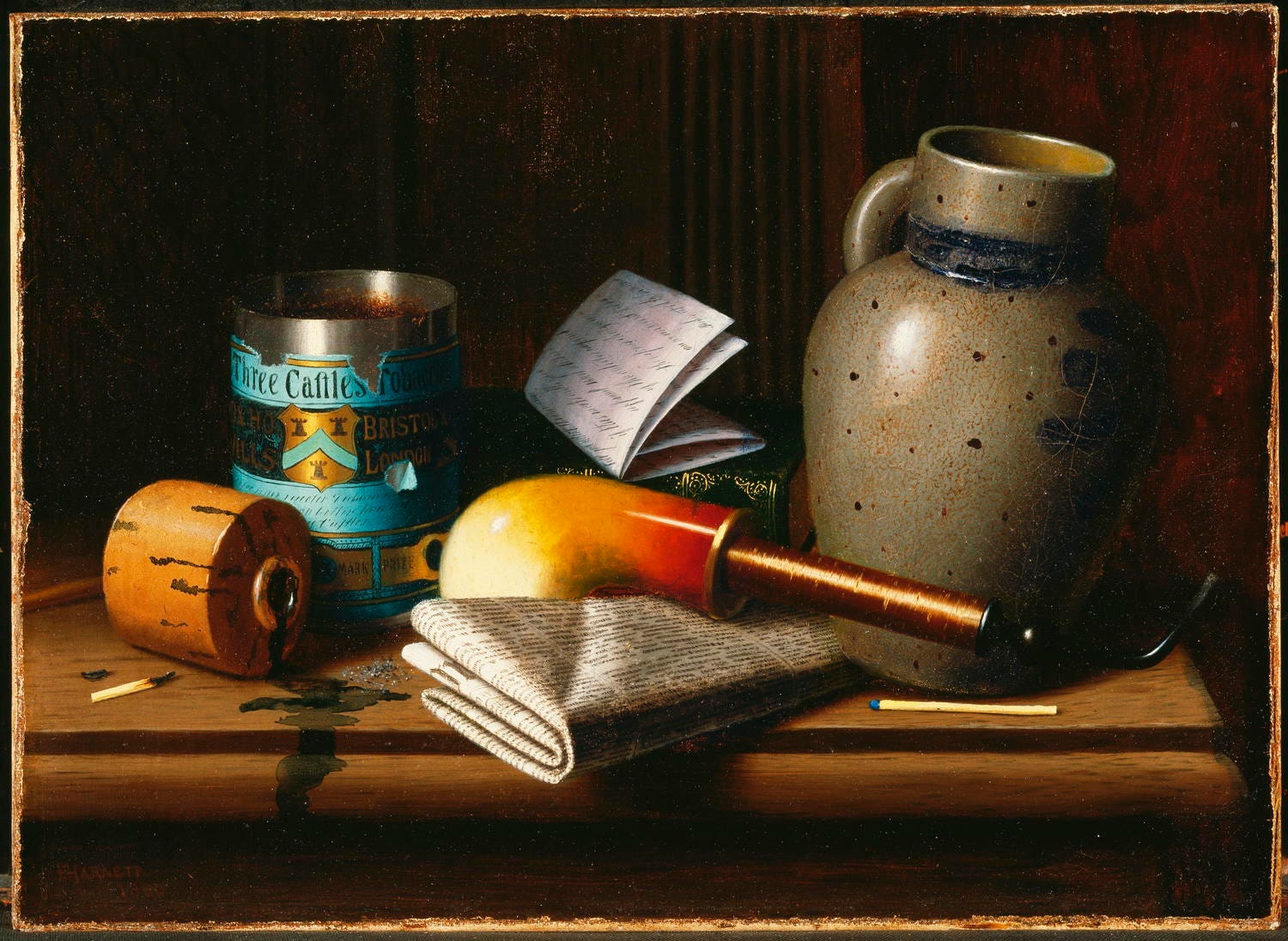
[The Brooklyn Museum’s object note on Hartnett’s Still Life with Three Castles Tobacco reads: “As the still-life genre became increasingly popular with collectors in the late nineteenth century, artists turned toward what was considered a more masculine subject matter, featuring the trophies of hunting or, as in this composition, pipes, jugs, books, and newspapers. William Michael Harnett’s works were favored by New York businessmen, who enjoyed them for their clever illusionistic style (seen in the way the newspaper juts forward) and their references to masculine pastimes.”]
Then comes John Frederick Peto’s Old Souvenirs (c. 1881–1901), an oil painting that resembles a scrapboard.
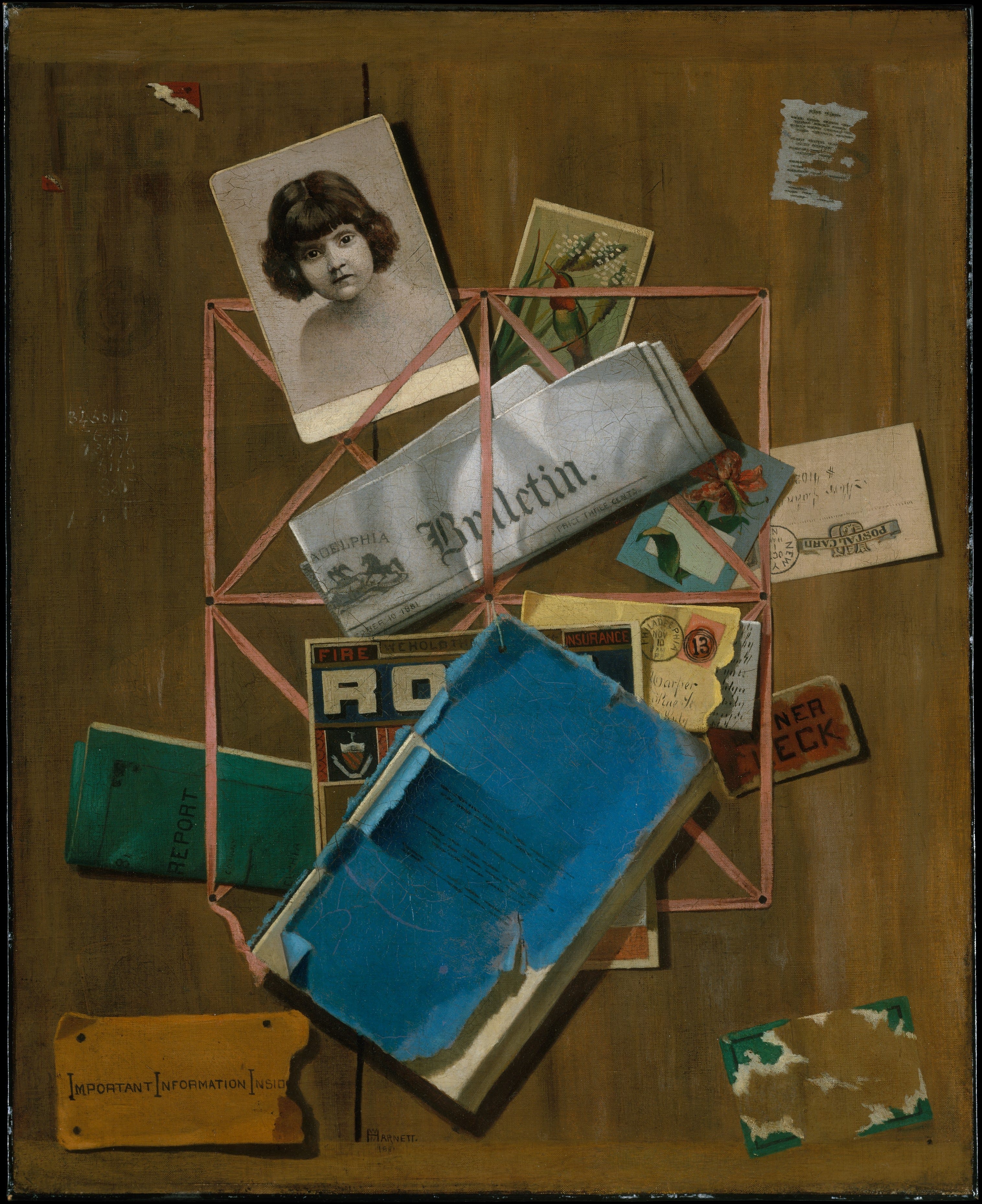
[According to The Met’s website: “This characteristic painting by Peto bears the false signature of William Michael Harnett, his better-known contemporary. Ironically, Harnett appears to have been inspired to create “rack” paintings by Peto’s work. Both Philadelphia artists studied and exhibited in the centennial years at the Pennsylvania Academy of the Fine Arts, the city’s leading arts institution, and gravitated toward similar still-life subjects. While Harnett seemed more interested in qualities of illusion, Peto’s pictures appear to carry greater psychological weight. Old Souvenirs presents tattered pieces of paper with personal meaning for the artist, including a photograph of his young daughter.”]
Scrap-boards aside, it is Barthelme’s collage technique that gets mounted in “Bishop”; sentences touch each briskly each other without the protection of transitions or ligament. The story staggers down the page in short paragraphs, often limited to a single sentence statement.
Even the opening sentence feels cursory and uninvested:
“Bishop’s standing outside his apartment building.”1
Without further ado, we move into the fray:
An oil struck double-parked, its hose coupled with the sidewalk, the green-uniformed driver reading a paperback called Name Your Baby.
Bishop’s waiting for Cara.
The martini rule is not before quarter to twelve.
Eyes go out of focus. He blinks them back again.
He had a beer for breakfast, as usual, a Pilsner Urquell.
Imported beer is now ninety-nine cents a bottle at his market.
The oil truck’s pump shuts off with a click. The driver tosses his book into the cab and begins uncoupling.
Cara’s not coming.
The painter John Frederick Peto made a living Playing cornet in a camp meeting for the last twenty years of his life, according to Alfred Frankenstein.
Bishop goes back inside the building and climbs one flight of stairs to his apartment.
His bank has lost the alimony payment he cables twice a month to his second wife, in London. He switches on the FM, dialing past two classical stations to reach Fleetwood Mac.
Bishop’s writing a biography of the nineteenth-century American painter William Michael Harnett. But today he can’t make himself work.
Cara’s been divorced, once.
At twenty minutes to twelve he makes himself a martini.
Hideous bouts of black anger in the evening. Then a word or a sentence in the tone she can’t bear. The next morning he remembers nothing about it.
“It’s impossible to miss the parallels between author and character in ‘Bishop’”, wrote Tracy Daughtery in his biography of Barthelme, “same age, same physical appearance, same home city, same general profession.”2
Barthelme never affirmed this comparison.
When “Bishop” was published, Barthelme said that he immediately started receiving “calls from friends, some of whom I hadn’t heard from in some time and all of whom were offering Tylenol and bandages.” Barthleme continued: “The assumption was that identification of the author with the character was not only permissible but invited. This astonished me. One uses one’s depressions as one uses everything else, but what I was doing was writing a story. Merrily merrily merrily merrily.”3
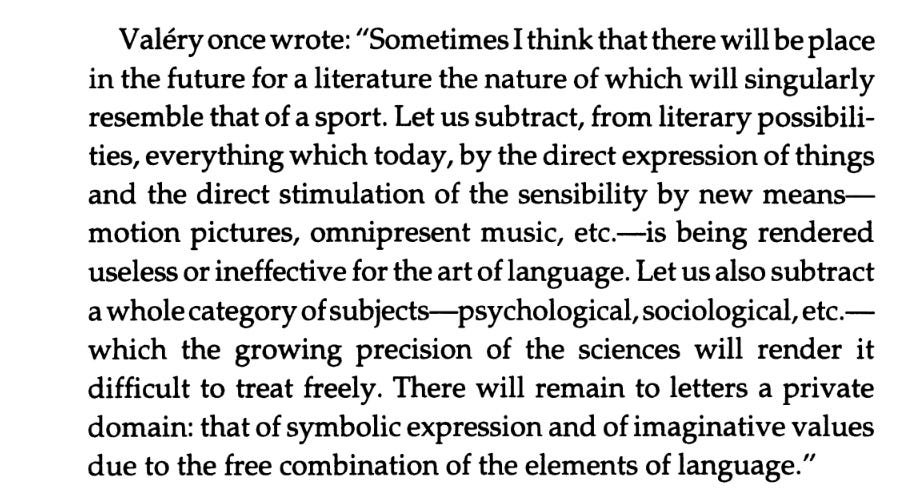
13 additional stories by Donald Barthelme
“The Explanation” (one of my personal favorites)
“The Hug”
“ENGINEER-PRIVATE PAUL KLEE MISPLACES AN AIRCRAFT BETWEEN MILBERTSHOFEN AND CAMBRAI, MARCH 1916”
That contraction is classic disorientation a la Bartheleme. “Bishop is standing” would be the correct English, but Barthelme (like John Ashbery) enjoyed leaving slight errancies in his sentences and constructions.
Tracy Daugherty, Hiding Man: A Biography of Donald Barthelme. New York: St. Martin’s Press, 2009.
Paris Review interview with Donald Barthelme in 1981.
This one comes courtesy of the indefatigable Bibliokept, whose archive of excerpts remains a treasure to writers and readers.